|
| void | parse_json_ (const char *data, size_t len) |
| |
| void | unlock_ () |
| |
| bool | wants_version_ () const |
| |
| void | request_version_ () |
| |
| void | send_version_request_ () |
| |
| void | parse_msg_number_ (const char *line, size_t len) |
| |
| void | parse_version_line_ (const char *line, size_t len) |
| |
| friend | void::setup () |
| |
| friend | void::original_setup () |
| |
| void | set_component_source_ (uint8_t index) |
| | Set where this component was loaded from for some debug messages.
|
| |
| virtual void | call_setup () |
| |
| void | call_dump_config_ () |
| |
| void | enable_loop_slow_path_ () |
| |
| void | set_component_state_ (uint8_t state) |
| | Helper to set component state (clears state bits and sets new state)
|
| |
| bool | set_status_flag_ (uint8_t flag) |
| | Helper to set a status LED flag on both this component and the app.
|
| |
| bool | set_error_flag_ (const LogString *message) |
| | Set the error flag and log it; true when it was not set before.
|
| |
| void | set_interval (const char *name, uint32_t interval, std::function< void()> &&f) |
| | Set an interval function with a const char* name.
|
| |
| void | set_interval (uint32_t id, uint32_t interval, std::function< void()> &&f) |
| | Set an interval function with a numeric ID (zero heap allocation).
|
| |
| void | set_interval (InternalSchedulerID id, uint32_t interval, std::function< void()> &&f) |
| |
| void | set_interval (uint32_t interval, std::function< void()> &&f) |
| |
| bool | cancel_interval (const char *name) |
| | Cancel an interval function.
|
| |
| bool | cancel_interval (uint32_t id) |
| |
| bool | cancel_interval (InternalSchedulerID id) |
| |
| void | set_timeout (const char *name, uint32_t timeout, std::function< void()> &&f) |
| | Set a timeout function with a const char* name.
|
| |
| void | set_timeout (uint32_t id, uint32_t timeout, std::function< void()> &&f) |
| | Set a timeout function with a numeric ID (zero heap allocation).
|
| |
| void | set_timeout (InternalSchedulerID id, uint32_t timeout, std::function< void()> &&f) |
| |
| void | set_timeout (uint32_t timeout, std::function< void()> &&f) |
| |
| bool | cancel_timeout (const char *name) |
| | Cancel a timeout function.
|
| |
| bool | cancel_timeout (uint32_t id) |
| |
| bool | cancel_timeout (InternalSchedulerID id) |
| |
| void | defer (const char *name, std::function< void()> &&f) |
| | Defer a callback to the next loop() call with a const char* name.
|
| |
| void | defer (std::function< void()> &&f) |
| | Defer a callback to the next loop() call.
|
| |
| void | defer (uint32_t id, std::function< void()> &&f) |
| | Defer a callback with a numeric ID (zero heap allocation)
|
| |
| bool | cancel_defer (const char *name) |
| | Cancel a defer callback using the specified name, name must not be empty.
|
| |
| bool | cancel_defer (uint32_t id) |
| |
| void | status_clear_warning_slow_path_ () |
| |
| void | status_clear_error_slow_path_ () |
| |
|
| virtual float | get_setup_priority () const |
| | priority of setup().
|
| |
| float | get_actual_setup_priority () const |
| |
| void | set_setup_priority (float priority) |
| |
| void | call () |
| |
| virtual void | on_safe_shutdown () |
| |
| virtual bool | teardown () |
| | Called during teardown to allow component to gracefully finish operations.
|
| |
| virtual void | on_powerdown () |
| | Called after teardown is complete to power down hardware.
|
| |
| uint8_t | get_component_state () const |
| |
| void | reset_to_construction_state () |
| | Reset this component back to the construction state to allow setup to run again.
|
| |
| bool | is_in_loop_state () const |
| | Check if this component has completed setup and is in the loop state.
|
| |
| bool | is_idle () const |
| | Check if this component is idle.
|
| |
| void | mark_failed () |
| | Mark this component as failed.
|
| |
| void | mark_failed (const LogString *message) |
| |
| void | disable_loop () |
| | Disable this component's loop.
|
| |
| void | enable_loop () |
| | Enable this component's loop.
|
| |
| void | enable_loop_soon_any_context () |
| | Thread and ISR-safe version of enable_loop() that can be called from any context.
|
| |
| bool | is_failed () const |
| |
| bool | is_ready () const |
| |
| virtual bool | can_proceed () |
| |
| bool | status_has_warning () const |
| |
| bool | status_has_error () const |
| |
| void | status_set_warning () |
| |
| void | status_set_warning (const char *message) |
| |
| void | status_set_warning (const LogString *message) |
| |
| bool | status_comm_result (bool ok) |
| | Clears the warning when ok, else sets it with message (default "Communication failed"); returns ok.
|
| |
| bool | status_comm_result (bool ok, const LogString *message) |
| |
| void | status_set_error () |
| |
| void | status_set_error (const LogString *message) |
| |
| void | status_clear_warning () |
| |
| void | status_clear_error () |
| |
| | ESPDEPRECATED ("Use status_momentary_warning() without a name. Removed in 2027.5.0", "2026.11.0") void status_momentary_warning(const char *name |
| |
| void | status_momentary_warning (uint32_t length=5000) |
| | Set warning status flag and clear it after length ms.
|
| |
| void | status_momentary_warning (const LogString *message, uint32_t length=5000) |
| |
| | ESPDEPRECATED ("Use status_momentary_error() without a name. Removed in 2027.5.0", "2026.11.0") void status_momentary_error(const char *name |
| |
| void | status_momentary_error (uint32_t length=5000) |
| | Set error status flag and clear it after length ms.
|
| |
| void | status_momentary_error (const LogString *message, uint32_t length=5000) |
| |
| bool | has_overridden_loop () const |
| |
| const LogString * | get_component_log_str () const ESPHOME_ALWAYS_INLINE |
| | Get the integration where this component was declared as a LogString for logging.
|
| |
| bool | should_warn_of_blocking (uint32_t blocking_time, uint32_t &threshold_ms_out) |
| |
| | UARTDevice ()=default |
| |
| | UARTDevice (UARTComponent *parent) |
| |
| void | set_uart_parent (UARTComponent *parent) |
| |
| void | write_byte (uint8_t data) |
| |
| void | set_rx_full_threshold (size_t rx_full_threshold) |
| |
| void | set_rx_full_threshold_ms (size_t time) |
| |
| size_t | get_rx_full_threshold () |
| |
| void | set_rx_timeout (size_t rx_timeout) |
| |
| size_t | get_rx_timeout () |
| |
| void | write_array (const uint8_t *data, size_t len) |
| |
| void | write_array_progmem (const uint8_t *data, size_t len) |
| |
| void | write_array (const std::vector< uint8_t > &data) |
| |
| template<size_t N> |
| void | write_array (const std::array< uint8_t, N > &data) |
| |
| void | write_str (const char *str) |
| |
| bool | read_byte (uint8_t *data) |
| |
| bool | peek_byte (uint8_t *data) |
| |
| bool | read_array (uint8_t *data, size_t len) |
| |
| template<size_t N> |
| optional< std::array< uint8_t, N > > | read_array () |
| |
| size_t | available () |
| |
| template<size_t N = 64, typename F > |
| bool | read_available_chunks (F &&on_chunk) |
| | Pass the bytes available now to on_chunk(data, len) in N byte chunks; returning false stops.
|
| |
| template<size_t N = 64, typename F > |
| bool | read_available_chunks (F &&on_chunk, size_t count) |
| | Same, reading exactly count bytes; count must not exceed available().
|
| |
| template<size_t N = 64, typename F > |
| bool | read_available (F &&on_byte) |
| | Same as read_available_chunks(), calling on_byte(uint8_t) once per byte.
|
| |
| template<size_t N = 64, typename F > |
| bool | read_available (F &&on_byte, size_t count) |
| |
| void | discard_available () |
| | Read and drop every byte waiting in the receive buffer.
|
| |
| UARTFlushResult | flush () |
| |
| int | read () |
| |
| size_t | write (uint8_t data) |
| |
| int | peek () |
| |
| | ESPDEPRECATED ("Use uart.final_validate_device_schema() in Python instead. Removed in 2027.3.0", "2026.9.0") void check_uart_settings(uint32_t baud_rate |
| | Check that the configuration of the UART bus matches the provided values and otherwise print a warning.
|
| |
| uint32_t | length = 5000) |
| |
| uint8_t | stop_bits = 1 |
| |
| uint8_t UARTParityOptions | parity = UART_CONFIG_PARITY_NONE |
| |
| uint8_t UARTParityOptions uint8_t | data_bits = 8) |
| |
| template<typename F , typename... A> |
| static bool | continue_after (F &f, A... args) |
| | Call f(args...) and return its result; a void callback always continues.
|
| |
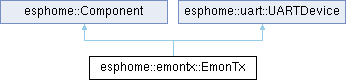
Main class for the EmonTx component.
The EmonTx processes incoming data frames via UART, extracts tags and values, and publishes them to registered sensors.
Definition at line 38 of file emontx.h.
 Protected Member Functions inherited from esphome::Component
 1.12.0