|
| | Camera () |
| |
| virtual void | add_listener (CameraListener *listener)=0 |
| | Add a listener to receive camera events.
|
| |
| virtual CameraImageReader * | create_image_reader ()=0 |
| | Returns a new camera image reader that keeps track of the JPEG data in the camera image.
|
| |
| virtual void | request_image (CameraRequester requester)=0 |
| |
| virtual void | start_stream (CameraRequester requester)=0 |
| |
| virtual void | stop_stream (CameraRequester requester)=0 |
| |
| virtual | ~Camera () |
| |
| | ESPDEPRECATED ("Use get_name_to() or get_log_name() instead. Will be removed in ESPHome 2027.5.0", "2026.11.0") const StringRef &get_name() const |
| | The name is in flash here; the first call makes a RAM copy that is kept for the life of the device.
|
| |
| StringRef | get_name_to (std::span< char, ENTITY_NAME_BUF_SIZE > buffer) const |
| | Get the name of this Entity, copied out of flash into buffer.
|
| |
| | ESPDEPRECATED ("Use get_name_to() or get_log_name() instead. Will be removed in ESPHome 2027.5.0", "2026.11.0") const StringRef &get_name() const |
| |
| const StringRef & | get_name_to (std::span< char, ENTITY_NAME_BUF_SIZE >) const |
| |
| bool | name_equals (const StringRef &other) const |
| |
| const ProgmemStringRef & | get_name_progmem () const |
| | The name as stored, for consumers that read flash themselves (e.g. API progmem fields).
|
| |
| size_t | write_name_to (char *buf, size_t buf_size) const |
| | Copy the name into buf (null terminated), returns its length.
|
| |
| const LogString * | get_log_name () const |
| | Get the name for a "%s" log argument (LOG_STR_ARG).
|
| |
| bool | has_own_name () const |
| |
| uint32_t | get_object_id_hash () const |
| |
| StringRef | get_object_id_to (std::span< char, OBJECT_ID_MAX_LEN > buf) const |
| | Get object_id with zero heap allocation For static case: returns StringRef to internal storage (buffer unused) For dynamic case: formats into buffer and returns StringRef to buffer.
|
| |
| size_t | write_object_id_to (char *buf, size_t buf_size) const |
| | Write object_id directly to buffer, returns length written (excluding null) Useful for building compound strings without intermediate buffer.
|
| |
| bool | is_internal () const |
| |
| void | set_internal (bool internal) |
| |
| bool | is_disabled_by_default () const |
| |
| EntityCategory | get_entity_category () const |
| |
| const char * | get_device_class_to (std::span< char, MAX_DEVICE_CLASS_LENGTH > buffer) const |
| |
| ProgmemStringRef | get_device_class_progmem () const |
| | The device class as stored (in flash on ESP8266), for consumers that read flash themselves.
|
| |
| StringRef | get_unit_of_measurement_ref () const |
| |
| const char * | get_icon_to (std::span< char, MAX_ICON_LENGTH > buffer) const |
| |
| ProgmemStringRef | get_icon_progmem () const |
| | The icon as stored (in flash on ESP8266), for consumers that read flash themselves.
|
| |
| uint32_t | get_device_id () const |
| |
| Device * | get_device () const |
| |
| bool | has_state () const |
| |
| void | set_has_state (bool state) |
| |
| | ESPDEPRECATED ("Use make_entity_preference<T>() instead, or preferences won't be migrated. " "See https://github.com/esphome/backlog/issues/85. Will be removed in 2027.1.0.", "2026.7.0") uint32_t get_preference_hash() |
| | Get a unique hash for storing preferences/settings for this entity.
|
| |
| template<typename T > |
| ESPPreferenceObject | make_entity_preference (uint32_t version=0) |
| | Create a preference object for storing this entity's state/settings.
|
| |
| template<typename T > |
| ESPPreferenceObject | make_entity_preference (uint32_t version, bool in_flash) |
| | As make_entity_preference(), stored in flash or RTC memory where the backend supports the choice.
|
| |
| virtual void | setup () |
| | Where the component's initialization should happen.
|
| |
| virtual void | loop () |
| | This method will be called repeatedly.
|
| |
| virtual void | dump_config () |
| |
| virtual float | get_setup_priority () const |
| | priority of setup().
|
| |
| float | get_actual_setup_priority () const |
| |
| void | set_setup_priority (float priority) |
| |
| void | call () |
| |
| virtual void | on_shutdown () |
| |
| virtual void | on_safe_shutdown () |
| |
| virtual bool | teardown () |
| | Called during teardown to allow component to gracefully finish operations.
|
| |
| virtual void | on_powerdown () |
| | Called after teardown is complete to power down hardware.
|
| |
| uint8_t | get_component_state () const |
| |
| void | reset_to_construction_state () |
| | Reset this component back to the construction state to allow setup to run again.
|
| |
| bool | is_in_loop_state () const |
| | Check if this component has completed setup and is in the loop state.
|
| |
| bool | is_idle () const |
| | Check if this component is idle.
|
| |
| void | mark_failed () |
| | Mark this component as failed.
|
| |
| void | mark_failed (const LogString *message) |
| |
| void | disable_loop () |
| | Disable this component's loop.
|
| |
| void | enable_loop () |
| | Enable this component's loop.
|
| |
| void | enable_loop_soon_any_context () |
| | Thread and ISR-safe version of enable_loop() that can be called from any context.
|
| |
| bool | is_failed () const |
| |
| bool | is_ready () const |
| |
| virtual bool | can_proceed () |
| |
| bool | status_has_warning () const |
| |
| bool | status_has_error () const |
| |
| void | status_set_warning () |
| |
| void | status_set_warning (const char *message) |
| |
| void | status_set_warning (const LogString *message) |
| |
| bool | status_comm_result (bool ok) |
| | Clears the warning when ok, else sets it with message (default "Communication failed"); returns ok.
|
| |
| bool | status_comm_result (bool ok, const LogString *message) |
| |
| void | status_set_error () |
| |
| void | status_set_error (const LogString *message) |
| |
| void | status_clear_warning () |
| |
| void | status_clear_error () |
| |
| | ESPDEPRECATED ("Use status_momentary_warning() without a name. Removed in 2027.5.0", "2026.11.0") void status_momentary_warning(const char *name |
| |
| void | status_momentary_warning (uint32_t length=5000) |
| | Set warning status flag and clear it after length ms.
|
| |
| void | status_momentary_warning (const LogString *message, uint32_t length=5000) |
| |
| | ESPDEPRECATED ("Use status_momentary_error() without a name. Removed in 2027.5.0", "2026.11.0") void status_momentary_error(const char *name |
| |
| void | status_momentary_error (uint32_t length=5000) |
| | Set error status flag and clear it after length ms.
|
| |
| void | status_momentary_error (const LogString *message, uint32_t length=5000) |
| |
| bool | has_overridden_loop () const |
| |
| const LogString * | get_component_log_str () const ESPHOME_ALWAYS_INLINE |
| | Get the integration where this component was declared as a LogString for logging.
|
| |
| bool | should_warn_of_blocking (uint32_t blocking_time, uint32_t &threshold_ms_out) |
| |
|
| uint32_t | length = 5000) |
| |
| friend | void::setup () |
| |
| friend | void::original_setup () |
| |
| void | configure_entity_ (const char *name, uint32_t object_id_hash, uint32_t entity_fields) |
| | Combined entity setup from codegen: set name, object_id hash, entity string indices, and flags.
|
| |
| void | set_device_ (Device *device) |
| |
| ESPPreferenceObject | make_entity_preference_ (size_t size, uint32_t version) |
| | Non-template helpers for make_entity_preference() to avoid code bloat.
|
| |
| ESPPreferenceObject | make_entity_preference_ (size_t size, uint32_t version, bool in_flash) |
| |
| uint32_t | entity_preference_key_ (uint32_t version) |
| | Key for both helpers; preference hash migration goes here.
|
| |
| friend | void::setup () |
| |
| friend | void::original_setup () |
| |
| void | set_component_source_ (uint8_t index) |
| | Set where this component was loaded from for some debug messages.
|
| |
| virtual void | call_setup () |
| |
| void | call_dump_config_ () |
| |
| void | enable_loop_slow_path_ () |
| |
| void | set_component_state_ (uint8_t state) |
| | Helper to set component state (clears state bits and sets new state)
|
| |
| bool | set_status_flag_ (uint8_t flag) |
| | Helper to set a status LED flag on both this component and the app.
|
| |
| bool | set_error_flag_ (const LogString *message) |
| | Set the error flag and log it; true when it was not set before.
|
| |
| void | set_interval (const char *name, uint32_t interval, std::function< void()> &&f) |
| | Set an interval function with a const char* name.
|
| |
| void | set_interval (uint32_t id, uint32_t interval, std::function< void()> &&f) |
| | Set an interval function with a numeric ID (zero heap allocation).
|
| |
| void | set_interval (InternalSchedulerID id, uint32_t interval, std::function< void()> &&f) |
| |
| void | set_interval (uint32_t interval, std::function< void()> &&f) |
| |
| bool | cancel_interval (const char *name) |
| | Cancel an interval function.
|
| |
| bool | cancel_interval (uint32_t id) |
| |
| bool | cancel_interval (InternalSchedulerID id) |
| |
| void | set_timeout (const char *name, uint32_t timeout, std::function< void()> &&f) |
| | Set a timeout function with a const char* name.
|
| |
| void | set_timeout (uint32_t id, uint32_t timeout, std::function< void()> &&f) |
| | Set a timeout function with a numeric ID (zero heap allocation).
|
| |
| void | set_timeout (InternalSchedulerID id, uint32_t timeout, std::function< void()> &&f) |
| |
| void | set_timeout (uint32_t timeout, std::function< void()> &&f) |
| |
| bool | cancel_timeout (const char *name) |
| | Cancel a timeout function.
|
| |
| bool | cancel_timeout (uint32_t id) |
| |
| bool | cancel_timeout (InternalSchedulerID id) |
| |
| void | defer (const char *name, std::function< void()> &&f) |
| | Defer a callback to the next loop() call with a const char* name.
|
| |
| void | defer (std::function< void()> &&f) |
| | Defer a callback to the next loop() call.
|
| |
| void | defer (uint32_t id, std::function< void()> &&f) |
| | Defer a callback with a numeric ID (zero heap allocation)
|
| |
| bool | cancel_defer (const char *name) |
| | Cancel a defer callback using the specified name, name must not be empty.
|
| |
| bool | cancel_defer (uint32_t id) |
| |
| void | status_clear_warning_slow_path_ () |
| |
| void | status_clear_error_slow_path_ () |
| |
| ProgmemStringRef | name_ |
| |
| uint32_t | object_id_hash_ {} |
| |
| Device * | device_ {} |
| |
| struct esphome::EntityBase::EntityFlags | flags_ |
| |
| uint8_t | device_class_idx_ {} |
| |
| uint8_t | uom_idx_ {} |
| |
| uint8_t | icon_idx_ {} |
| |
| uint8_t | component_source_index_ {0} |
| | Index into component source PROGMEM lookup table (0 = not set)
|
| |
| uint8_t | warn_if_blocking_over_ {WARN_IF_BLOCKING_OVER_CS} |
| | Warn threshold in centiseconds (max 2550ms)
|
| |
| uint8_t | component_state_ {0x00} |
| | State of this component - each bit has a purpose: Bits 0-2: Component state (0x00=CONSTRUCTION, 0x01=SETUP, 0x02=LOOP, 0x03=FAILED, 0x04=LOOP_DONE) Bit 3: STATUS_LED_WARNING Bit 4: STATUS_LED_ERROR Bit 5: Has overridden loop() (set at registration time) Bits 6-7: Unused - reserved for future expansion.
|
| |
| volatile bool | pending_enable_loop_ {false} |
| | ISR-safe flag for enable_loop_soon_any_context.
|
| |
| ComponentRuntimeStats | runtime_stats_ |
| |
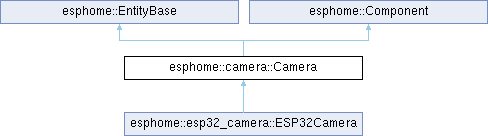
Abstract camera base class.
Collaborates with API. 1) API server starts and registers as a listener (add_listener) to receive new images from the camera. 2) API connection creates an image reader (create_image_reader) when it receives the first image it will send. 3) API connection receives protobuf CameraImageRequest and calls request_image. 3.a) API connection receives protobuf CameraImageRequest and calls start_stream. 4) Camera implementation provides JPEG data in the CameraImage and notifies listeners. 5) API connection sets the image in the image reader. 6) API connection consumes data from the image reader and returns the image when finished. 7.a) Camera captures a new image and continues with 4) until start_stream is called.
Definition at line 116 of file camera.h.
 Public Member Functions inherited from esphome::EntityBase
 1.12.0